American Option Dynamic Chebyshev Case Study
This technical blog asks a narrow but useful question: for a controlled American option problem with a known transition law, can a Dynamic Chebyshev solver reproduce a trusted quant-library price while evaluating much faster than simulation or finite-difference re-pricing?
The answer in this case study is yes. The reason is not that Chebyshev interpolation blindly learns the whole exercise policy. The useful split is:
non-smooth part:  exercise decision, max(payoff, continuation)
smooth part:      continuation value under the known transition law
The example keeps the stopping decision explicit and applies Chebyshev interpolation to the smoother continuation-value functions inside a finite-horizon Bellman recursion. This is the same numerical-analysis idea used in Dynamic Chebyshev methods for American-style products: isolate the conditional expectation, approximate it accurately, then apply the exercise rule outside the interpolant.
Scope of the "Dynamic Chebyshev" name. The term follows Glau, Mahlstedt & Pötz (2019). This case study implements that idea — Chebyshev interpolation of the continuation value inside a backward Bellman recursion, with the
maxstopping rule applied exactly — but not their specific offline/online algorithm, in which a family of generalized moments \(\mathbb{E}[T_k(S_{i+1}) \mid S_i = x_j]\) is precomputed once so the online recursion needs no fresh expectations. Here the conditional expectation is recomputed by Gauss-Hermite quadrature at every step (see the Proposed Method section below). It is "inspired by," not a reimplementation of, that paper.
The runnable harness lives in examples/AmericanOptionDynamicChebyshev.
dotnet run --project examples/AmericanOptionDynamicChebyshev/AmericanOptionDynamicChebyshev.csproj
For the general theory behind this study — Markov decision processes, value and policy iteration, and how Chebyshev collocation compares to finite differences, regression, and neural networks — see From MDPs to Chebyshev Collocation. For a shorter reusable recipe focused on the implementation pattern, see Continuous-State Dynamic Programming.
Executive Result
The product is a one-year American put under the Black-Scholes-Merton model:
| Input | Value |
|---|---|
| Spot | 100 |
| Strike | 100 |
| Risk-free rate | 5% |
| Dividend yield | 0% |
| Volatility | 20% |
| Valuation date | 2026-05-15 |
| Maturity | 2027-05-15 |
One representative local run gives:
| Method | Price | Role |
|---|---|---|
| QLNet finite difference | 6.088238 |
Numerical oracle |
| QLNet analytic European | 5.573526 |
Lower control |
| Longstaff-Schwartz regression | 6.080847 |
Simulation price baseline |
| Stanford-style LSPI | 5.745344 |
RL price baseline |
| Dynamic Chebyshev | 6.083607 |
Proposed price-and-Greeks solver |
Dynamic Chebyshev is within 0.004631 price points of the QLNet finite
difference oracle on the at-the-money request. After build, the reusable
Chebyshev model evaluates price, Delta, and Gamma in 7.339 us in the local
benchmark, versus 33.780 ms for the tutorial's QLNet reference path. That is
an online speedup of 4602.8x. The QLNet timing includes the adapter's
bump-and-reprice Delta and Gamma path, not only a raw NPV call.
Benchmark scope. These are single, representative local runs on the reference rig (12th Gen Intel Core i7-12700K, .NET 10 Release), not averaged benchmarks; absolute timings and the speedup are machine- and run-dependent. Prices and grid errors are deterministic and reproduce exactly. The QLNet reference path additionally prices a European option analytically on every call, which the Chebyshev online path does not, so the headline ratio overstates the like-for-like pricing gap somewhat. See Performance for methodology.
Numerical Oracle
The correctness oracle is QLNet, the C# port of QuantLib-style APIs. QuantLib and QLNet support American vanilla options with numerical engines such as finite differences and binomial trees. The case study uses the finite-difference Black-Scholes engine as the reference and a Cox-Ross-Rubinstein tree as an independent cross-check.
The reference construction is:
AmericanOptionRequest
  -> QLNet PlainVanillaPayoff
  -> QLNet AmericanExercise(payoffAtExpiry: true)
  -> QLNet BlackScholesMertonProcess
  -> QLNet MakeFdBlackScholesVanillaEngine
       .withTGrid(300)
       .withXGrid(300)
       .withDampingSteps(0)
  -> NPV, bumped Delta, bumped Gamma
The market objects are intentionally simple: Actual365Fixed, NullCalendar,
flat risk-free and dividend curves, and BlackConstantVol. The cross-check tree
uses BinomialVanillaEngine<CoxRossRubinstein> with the same request. The
European lower control uses AnalyticEuropeanEngine.
The baseline is checked before any approximation is trusted:
- An American put must be worth at least the European put.
- A non-dividend American call should match the European call within numerical tolerance.
- Finite-difference and high-step binomial prices must agree within a small band.
- Put price must decrease as spot rises and increase as volatility rises.
- Bumped Delta and Gamma must have sensible signs away from boundary pathologies.
These checks prevent the tutorial from benchmarking against a broken local option pricer.
The Stopping Problem
At exercise date \(t_i\), the holder compares immediate exercise with continuation. For a put with strike \(K\),
The finite-horizon dynamic program is
The difficult object is the stopping rule near the exercise boundary. The
continuation value \(C_i\) is usually smoother than the full value
\(V_i=\max(h,C_i)\). Dynamic Chebyshev exploits that structure by approximating
the continuation function and leaving the max operation exact.
Under Black-Scholes-Merton dynamics,
Because this transition law is known, the conditional expectation can be computed by quadrature instead of learned statistically from paths.
Reporting Format
This page follows the style of a numerical study, not only an API walkthrough. American-option simulation papers and the Kan thesis compare estimates against trusted references before interpreting runtime. Chebyshev finance papers use a similar discipline: compare against a benchmark pricing engine, test away from interpolation nodes, and separate offline build cost from online evaluation. The MoCaX/Ruiz-Zeron sensitivity papers also stress accuracy at risk-relevant points, not only average price error.
For this tutorial, the clearest risk-review format is a case table. For each spot case, report the QLNet ground truth, the Dynamic Chebyshev value, and the relative difference for price, Delta, and Gamma.
| Field | Why it matters |
|---|---|
| Price estimate | Shows whether the method lands near the reference value. |
| QLNet sensitivity | Gives the finite-difference ground truth for the Greek. |
| Dynamic Chebyshev sensitivity | Shows what the reusable model returns online. |
| Relative difference | Makes errors comparable across price, Delta, and Gamma. |
| Runtime or build time | Shows whether the method is useful in a repeated risk loop. |
| Online evaluation time | Measures the reusable model after build. |
A single aggregate error number can hide where a method is accurate and where it is weak. The 10-case tables below are therefore the main accuracy evidence for the baselines and the Dynamic Chebyshev candidate.
Related Work and Baselines
The two statistical baselines represent the simulation-based and reinforcement-learning approaches commonly used for American exercise problems. Both are legitimate methods. The point of this page is narrower: when the model is known and the state is low-dimensional, deterministic Bellman collocation can be cleaner, faster online, and less noisy.
Longstaff-Schwartz least-squares Monte Carlo estimates continuation by regressing discounted future cashflows on basis functions of the current state. It is simple and general, especially for path-dependent payoffs. The tradeoff is that the estimate depends on path count, random seed, basis choice, and exercise boundary quality. The Kan thesis uses this regression-Monte-Carlo family as a starting point and then studies bias, variance reduction, and computing time. The one-factor put used in this tutorial is not the same product as the thesis tables, so this page includes a separate thesis-style max-call check under Baseline Candidate 1.
Least-Squares Policy Iteration (LSPI), following the Stanford American-option reinforcement-learning notes, treats exercise as an action-value problem. The payoff for exercise is known exactly, while continuation is fitted from simulated transitions. This is attractive when the policy must be learned from samples, but it still inherits sampling error and feature sensitivity. Near the exercise boundary, a small continuation error can change the action.
Dynamic Chebyshev follows the same Bellman recursion, but it uses deterministic Chebyshev interpolation and quadrature for the continuation function. This is most natural when the transition model is known and the state dimension is controlled. It is not trying to learn the exercise payoff. It approximates the smooth continuation object, then applies the stopping decision exactly.
Baseline Candidate 1: Longstaff-Schwartz
Method Role
This candidate answers the simulation question: if we use the standard regression-Monte-Carlo idea, how close do we get before adding Chebyshev? It is a legitimate baseline because it is model-flexible and widely used for American-style products.
Longstaff-Schwartz simulates paths and works backward. At each exercise date, only in-the-money paths are used for the regression. In this harness the continuation basis is
Algorithm
Algorithm inputs: option request, path count \(M\), and exercise-step count \(N\).
- Simulate \(M\) risk-neutral spot paths \(S_{m,0},\ldots,S_{m,N}\).
- At maturity, set each path's stored cashflow to \(h(S_{m,N})\).
- For each exercise step \(i=N-1,\ldots,1\), work backward:
- Keep only paths where immediate exercise has positive value, \(h(S_{m,i})>0\).
- Discount each selected path's currently stored future cashflow back to step \(i\).
- Regress those discounted cashflows on \(1\), \(S/K\), and \((S/K)^2\).
- If \(h(S_{m,i})\) is greater than the fitted continuation value, replace that path's stored cashflow with \(h(S_{m,i})\) at step \(i\).
- Discount each realized cashflow to time 0.
- Return the average present value.
Price Baseline Result
The implemented baseline uses 12,000 paths, 50 exercise steps, and seed
8675309.
| Metric | Value |
|---|---|
| QLNet FD price | 6.088238 |
| LSM price | 6.080847 |
| Absolute price difference | 0.007391 |
| Runtime for one estimate | 54.169 ms |
| Exercised-path fraction | 39.10% |
Thesis Comparable Check
The one-factor put above is the tutorial problem. To verify that the LSM implementation is also numerically comparable to the Kan thesis, the example includes a separate Table 2.1-style benchmark:
dotnet run --project examples/AmericanOptionDynamicChebyshev/AmericanOptionDynamicChebyshev.csproj -- --thesis-benchmark
This benchmark uses the thesis Table 2.1 n=2 Bermudan max-call setup:
| Setting | Value |
|---|---|
| Asset count | 2 |
| Payoff | max(max(S_1,S_2)-K,0) |
| Initial spots | 90, 100, 110 |
| Strike | 100 |
| Risk-free rate | 5% |
| Dividend yield | 10% |
| Volatility | 20% |
| Correlation | 0 |
| Maturity | 3 years |
| Exercise dates | 9 equally spaced dates |
| Paths | 200,000 |
| Regression basis | 10 polynomials in the highest and second-highest asset prices |
The thesis values are the LS column from Table 2.1. The ChebyshevSharp values
come from the local thesis benchmark mode.
| Assets | \(S_0\) | Thesis LS | Thesis SE | ChebyshevSharp LS | Abs. diff. | Rel. diff. |
|---|---|---|---|---|---|---|
2 |
90 |
8.063 |
0.010 |
8.066 |
0.003 |
0.033% |
2 |
100 |
13.861 |
0.012 |
13.860 |
0.001 |
0.004% |
2 |
110 |
21.333 |
0.014 |
21.276 |
0.057 |
0.268% |
This is the numerical comparability check. It is distinct from the main
one-factor American put case study, but it confirms that the local LSM
implementation agrees with the thesis benchmark at the same product settings to
within about 0.3% in these three cases.
10-Case Price and Sensitivity Assessment
The LSM sensitivities below are finite-difference bump-and-reprice estimates
using the same fixed seed and SpotBump = 0.5. They are not analytic Greeks.
Price comparison:
| Spot | QLNet price | LSM price | Relative difference |
|---|---|---|---|
82.0 |
18.020345 |
17.965078 |
0.307% |
86.0 |
14.480421 |
14.483739 |
0.023% |
90.0 |
11.489487 |
11.460314 |
0.254% |
94.0 |
8.998778 |
8.922124 |
0.852% |
98.0 |
6.957290 |
6.938699 |
0.267% |
102.0 |
5.311128 |
5.302969 |
0.154% |
106.0 |
4.005139 |
3.991870 |
0.331% |
110.0 |
2.985232 |
2.953272 |
1.071% |
114.0 |
2.200635 |
2.182341 |
0.831% |
118.0 |
1.605555 |
1.602980 |
0.160% |
Sensitivity comparison:
| Spot | QLNet Delta | LSM Delta | Delta rel. diff. | QLNet Gamma | LSM Gamma | Gamma rel. diff. |
|---|---|---|---|---|---|---|
82.0 |
-0.957158 |
-0.950137 |
0.734% |
0.033689 |
0.103618 |
207.577% |
86.0 |
-0.814364 |
-0.788366 |
3.192% |
0.034124 |
0.099890 |
192.724% |
90.0 |
-0.683188 |
-0.706733 |
3.446% |
0.031324 |
0.056333 |
79.842% |
94.0 |
-0.564363 |
-0.537247 |
4.805% |
0.028079 |
0.161166 |
473.965% |
98.0 |
-0.458708 |
-0.449934 |
1.913% |
0.024705 |
0.163590 |
562.171% |
102.0 |
-0.366762 |
-0.364090 |
0.729% |
0.021294 |
-0.029671 |
239.337% |
106.0 |
-0.288568 |
-0.286664 |
0.660% |
0.017889 |
-0.038363 |
314.449% |
110.0 |
-0.223566 |
-0.224171 |
0.270% |
0.014690 |
0.016238 |
10.536% |
114.0 |
-0.170692 |
-0.180656 |
5.837% |
0.011815 |
0.018202 |
54.060% |
118.0 |
-0.128548 |
-0.131561 |
2.344% |
0.009321 |
0.017037 |
82.791% |
Assessment
LSM gets a close price in this one run, which is why it is a useful baseline. However, the case table shows why this plain implementation is not a good risk clone. Delta is usable in some regions but inconsistent, and Gamma is unstable because it is a second finite difference of a noisy regression estimate. A production Monte Carlo Greek workflow would need extra machinery such as common random numbers, path reuse, smoothing, or separate Greek estimators.
Baseline Candidate 2: Stanford-Style LSPI
Method Role
This candidate answers the reinforcement-learning question: if we learn an exercise policy from simulated transitions, does that beat a direct numerical Bellman solver on this controlled problem? The answer here is no. The experiment is still useful because it shows why a known transition law should not automatically be treated as a model-free learning problem.
The RL baseline uses a linear continuation action value. Exercise is not learned; it is the known payoff:
Continuation is represented as
where \(\phi(s)\) contains Laguerre-style functions of \(S/K\) plus simple time-to-maturity features. The policy is
Algorithm
Algorithm inputs: option request, path count \(M\), exercise-step count \(N\), and maximum policy-iteration count \(L\).
- Simulate \(M\) risk-neutral training paths.
- Initialize the continuation weights with \(w=0\).
- For each policy iteration \(1,\ldots,L\):
- For every transition \((S_i,S_{i+1})\) on the training paths, compute the feature vector \(\phi(S_i,i)\).
- Under the current policy, decide whether the next state \(S_{i+1}\) continues or exercises.
- Add the transition to the linear policy-evaluation system.
- Solve the regularized linear system for updated weights.
- Stop if the weights no longer change materially.
- Simulate independent evaluation paths.
- Apply the learned policy: exercise when \(h(S_i)>w^\top\phi(S_i,i)\); otherwise continue.
- Return the discounted payoff average.
Price Baseline Result
The implemented baseline uses 12,000 paths, 50 exercise steps, seed 13579,
and up to 12 policy iterations.
| Metric | Value |
|---|---|
| QLNet FD price | 6.088238 |
| LSPI price | 5.745344 |
| Absolute price difference | 0.342894 |
| Runtime for one train/evaluate run | 2147.811 ms |
| Policy iterations used | 10 |
| Feature count | 7 |
| Boundary exercise decisions | 3585 |
10-Case Price and Sensitivity Assessment
The LSPI sensitivities are also finite-difference bump-and-reprice estimates
using the same fixed seed and SpotBump = 0.5.
Price comparison:
| Spot | QLNet price | LSPI price | Relative difference |
|---|---|---|---|
82.0 |
18.020345 |
17.866411 |
0.854% |
86.0 |
14.480421 |
14.261597 |
1.511% |
90.0 |
11.489487 |
10.441624 |
9.120% |
94.0 |
8.998778 |
8.332084 |
7.409% |
98.0 |
6.957290 |
6.530878 |
6.129% |
102.0 |
5.311128 |
5.050101 |
4.915% |
106.0 |
4.005139 |
3.837158 |
4.194% |
110.0 |
2.985232 |
2.886170 |
3.318% |
114.0 |
2.200635 |
2.147930 |
2.395% |
118.0 |
1.605555 |
1.598846 |
0.418% |
Sensitivity comparison:
| Spot | QLNet Delta | LSPI Delta | Delta rel. diff. | QLNet Gamma | LSPI Gamma | Gamma rel. diff. |
|---|---|---|---|---|---|---|
82.0 |
-0.957158 |
-0.970962 |
1.442% |
0.033689 |
-0.082932 |
346.172% |
86.0 |
-0.814364 |
-0.895293 |
9.938% |
0.034124 |
0.161613 |
373.598% |
90.0 |
-0.683188 |
-0.752912 |
10.206% |
0.031324 |
0.770025 |
2,358.283% |
94.0 |
-0.564363 |
-0.491628 |
12.888% |
0.028079 |
-0.032893 |
217.145% |
98.0 |
-0.458708 |
-0.406196 |
11.448% |
0.024705 |
-0.023766 |
196.198% |
102.0 |
-0.366762 |
-0.338874 |
7.604% |
0.021294 |
0.035751 |
67.889% |
106.0 |
-0.288568 |
-0.260818 |
9.617% |
0.017889 |
-0.020637 |
215.357% |
110.0 |
-0.223566 |
-0.218171 |
2.413% |
0.014690 |
-0.003586 |
124.411% |
114.0 |
-0.170692 |
-0.166944 |
2.196% |
0.011815 |
0.042181 |
257.019% |
118.0 |
-0.128548 |
-0.129953 |
1.093% |
0.009321 |
-0.012735 |
236.635% |
Assessment
The LSPI result is materially below the QLNet finite-difference oracle. The
fitted continuation/action boundary is not accurate enough near the exercise
region, so the policy gives up too much exercise value. The case table also
shows that the sensitivity profile is not acceptable for this risk-use case:
Delta is often off by several percent, and Gamma is frequently wrong by more
than 100%.
This is an important negative result. RL-style policy learning is valuable when the transition law is unknown, when data arrives from an environment, or when a large state/action space makes deterministic collocation impossible. In this one-factor Black-Scholes-Merton benchmark, the transition law is known and the continuation expectation can be computed directly. Learning the policy adds variance and feature risk without solving a harder information problem.
Continuous-State Dynamic Programming Context
This case study is a continuous-state, finite-horizon dynamic program. The general theory — Markov decision processes, the Bellman equation, contraction and value/policy iteration, why a continuous state cannot be tabulated, and how Chebyshev collocation compares to regression, neural networks, and finite differences — is developed in From MDPs to Chebyshev Collocation. This section states only what is specific to the American-option problem solved here.
The reframing that makes the method work is that the transition law is known. Under one-factor Black-Scholes the conditional distribution of \(S_{i+1}\) given \(S_i=S\) is available in closed form, so the continuation value
is a computable operator, not an object that must be inferred from realised cashflows. Longstaff-Schwartz and LSPI estimate it from sampled paths because they treat the model as unknown; here it is evaluated directly by quadrature. The data are not the teacher — the Bellman equation is.
This is the smooth/non-smooth split the whole design rests on. The continuation value \(C_i\) is smooth and is the single object approximated by a Chebyshev interpolant; the exercise decision is the exact, non-smooth comparison
Because the action set is the two-element \(\{\text{exercise},\text{continue}\}\), the policy is a direct comparison of two known numbers — no continuous-action optimiser and no reinforcement-learning exploration are required. Maturity supplies the terminal condition \(V_N(S)=h(S)\), so the solver walks backward through the exercise dates; it does not use the infinite-horizon fixed point \(V=T[V]\) or any policy-iteration convergence loop. (The primer explains why finite-horizon backward induction is value iteration that simply terminates after \(N\) sweeps.)
ContinuousDPs.jl is cited as a conceptual reference for this model-based, collocation view of dynamic
programming, not as an American-option pricing engine; its generic solver performs a per-node
continuous-action maximisation that this two-action stopping problem does not need. The
What Was Parity Checked section below states exactly what is and is not validated against it.
The concrete collocation step — building the continuation interpolant through model-computed targets at the Chebyshev spot nodes, and the Gauss-Hermite quadrature that produces those targets — is given in the Proposed Method: Dynamic Chebyshev section below.
Glossary
| Term | Meaning in this page |
|---|---|
| Value function \(V_i(S)\) | The option value at exercise date \(i\) and spot \(S\), after making the best exercise/continue decision. |
| Payoff \(h(S)\) | The immediate exercise value. For the put, \(h(S)=\max(K-S,0)\). |
| Continuation value \(C_i(S)\) | The discounted expected value of not exercising today and behaving optimally later. |
| Bellman operator \(T[\cdot]\) | The rule that maps a next-step value function into today's continuation value by transition, expectation, and discounting. |
| Collocation node | A representative state point where the approximation is required to match the Bellman update. |
| Exercise boundary | The spot where payoff and continuation are equal. On one side exercise is optimal; on the other side continuation is optimal. |
Boundary Picture
Run:
dotnet run --project examples/AmericanOptionDynamicChebyshev/AmericanOptionDynamicChebyshev.csproj -- --boundary-diagnostics
The first-step decision compares payoff \(h(S)\) and continuation \(C(S)\). The boundary is where the two curves cross:
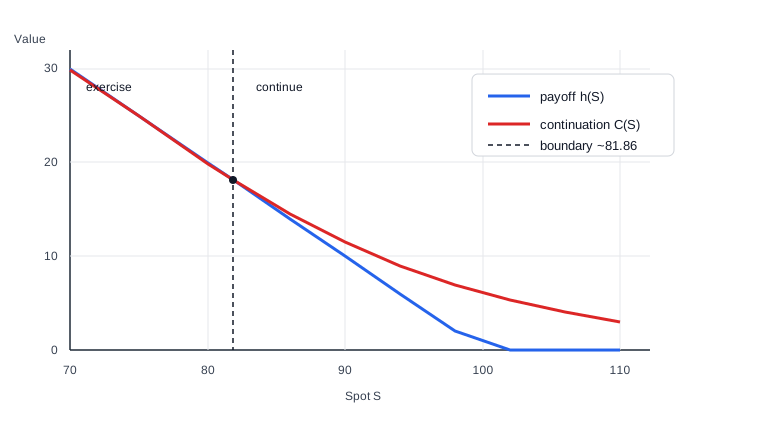
Representative values from the diagnostics mode:
| Spot | Payoff \(h(S)\) | Continuation \(C(S)\) | Decision | \(C(S)-h(S)\) |
|---|---|---|---|---|
70.0 |
30.000000 |
29.935791 |
exercise | -0.064209 |
75.0 |
25.000000 |
24.940874 |
exercise | -0.059126 |
80.0 |
20.000000 |
19.942732 |
exercise | -0.057268 |
82.0 |
18.000000 |
18.006888 |
continue | 0.006888 |
90.0 |
10.000000 |
11.479677 |
continue | 1.479677 |
100.0 |
0.000000 |
near 6.083607 |
continue | positive |
The estimated first-step boundary in this run is around spot 81.86. This is
also why small continuation errors near the boundary matter: the value itself
may be close, but the exercise/continue decision can flip when \(h(S)\) and
\(C(S)\) are nearly equal.
Why the boundary kink costs accuracy
The boundary is a kink, and that is what bounds the method's accuracy. Smooth pasting makes the value \(C^1\) across \(B_i\) (the slopes match), but the second derivative \(V_{SS}\) jumps there -- zero in the exercise region, positive in the continuation region. A jump in the second derivative is a \(\nu = 2\) singularity, so a global Chebyshev interpolant over the whole spot domain converges only algebraically, \(O(n^{-2})\), near the boundary instead of geometrically (see Kinks vs jumps).
The current solver interpolates the continuation with a single 81-node
ChebyshevApproximation over [5, 250] and places no knot at the boundary,
so each step's continuation carries this mild non-smoothness across \(B_i\). The
value error stays small -- payoff and continuation nearly coincide at the
boundary, so a misplaced corner barely moves the price -- but the damage
concentrates in the second derivative. That is exactly why the worst metric
in the study is Gamma at spot 82.0 (the row next to the \(\approx 81.86\)
boundary): 23.7% relative, while price and Delta stay accurate.
The principled remedy is to split at the boundary: locate \(B_i\) each step by
root-finding the payoff \(=\) continuation crossing and represent the continuation
as a two-piece ChebyshevSpline with the knot at \(B_i\), so each
piece is smooth and spectral accuracy (and clean Greeks) return. The trade-off
is that \(B_i\) moves every step, so the two boundary-straddling pieces relocate --
the method tolerates the kink today precisely to keep the per-step work cheap and
reusable.
Bellman Diagnostics
The current example does not expose a full residual curve for every backward step. It does include the checks below, which are the minimum diagnostics needed to trust the implemented Bellman layer before comparing prices:
| Check | Result | Purpose |
|---|---|---|
| Transition first-moment residual | < 1e-12 in unit test |
Verifies the risk-neutral transition and discounting used by the expectation operator. |
| Max spot-grid price abs. error vs QLNet FD | 1.346E-002 |
Checks the solved value against the numerical oracle away from only one point. |
| Max spot-grid Delta abs. error vs QLNet FD | 1.112E-002 |
Checks first sensitivity from the reusable model. |
| Max spot-grid Gamma abs. error vs QLNet FD | 7.993E-003 |
Checks second sensitivity, which is the most fragile metric here. |
| Estimated first-step boundary | 81.86 spot |
Confirms the payoff/continuation switch is visible and inspectable. |
A stronger future diagnostic would store each time-step continuation interpolant and report a Bellman residual curve on dense validation nodes. That would make the page even closer to a numerical-analysis paper.
Proposed Method: Dynamic Chebyshev
Method Role
This candidate answers the numerical-analysis question: if the model is known, can we approximate the continuation value deterministically and keep the exercise decision exact? This is the method the page is trying to motivate. It does not estimate continuation from realized paths. It builds continuation functions on Chebyshev nodes and reuses them for online price and Greeks.
Dynamic Chebyshev keeps the same Bellman equation but replaces pathwise continuation estimation with deterministic interpolation and quadrature. At time step \(i\), build a one-dimensional Chebyshev approximation of \(\widehat{C}_i(S)\) on a bounded spot domain:
The expectation is evaluated with 8-point Gauss-Hermite quadrature. With nodes \(x_m\) and weights \(w_m\),
The exercise value remains exact:
Algorithm
Algorithm inputs: option request, spot domain \([S_{\min},S_{\max}]\), exercise-step count \(N\), Chebyshev node count \(n\), and quadrature node count \(q\).
- Set the terminal value to \(V_N(S)=h(S)\).
- For each exercise step \(i=N-1,\ldots,0\), work backward:
- For each Chebyshev spot node \(S_j\in[S_{\min},S_{\max}]\), map each Gauss-Hermite node into a next spot \(S_{\mathrm{next}}\).
- Evaluate \(V_{i+1}(S_{\mathrm{next}})\).
- Discount and average the quadrature values to get \(C_i(S_j)\).
- Build a Chebyshev interpolant for \(C_i(S)\).
- Define the stopping value as \(V_i(S)=\max(h(S),C_i(S))\).
- Store the first-step continuation interpolant.
- For online evaluation at spot \(S\):
- Evaluate continuation, Delta, and Gamma from the interpolant.
- Compare continuation with exact payoff.
- Return price, Delta, and Gamma from the active branch.
Local Result
The implemented settings are 80 exercise steps, 81 spot nodes on
[5, 250], and quadrature order 8. The build uses 6,480 source evaluations
and takes 0.068s in the representative run.
| Metric | Value |
|---|---|
| Price | 6.083607 |
| Absolute error versus QLNet FD | 0.004631 |
| Standard error | deterministic |
| Build evaluations | 6,480 |
| Build time | 0.068s |
| Online price/Delta/Gamma evaluation | 7.339 us |
| QLNet reference price/Delta/Gamma path | 33.780 ms |
| Online speedup after build | 4602.8x |
| Spot-grid max price absolute error | 1.346E-002 |
| Spot-grid max Delta absolute error | 1.112E-002 |
| Spot-grid max Gamma absolute error | 7.993E-003 |
10-Case Price and Sensitivity Assessment
The case-level assessment is the main risk check. It compares QLNet finite difference ground truth against the reusable Dynamic Chebyshev model at 10 spot levels. Run it with:
dotnet run --project examples/AmericanOptionDynamicChebyshev/AmericanOptionDynamicChebyshev.csproj -- --case-assessment
The relative difference is
Price comparison:
| Spot | QLNet price | Dynamic Chebyshev price | Relative difference |
|---|---|---|---|
82.0 |
18.020345 |
18.006888 |
0.075% |
86.0 |
14.480421 |
14.469788 |
0.073% |
90.0 |
11.489487 |
11.479677 |
0.085% |
94.0 |
8.998778 |
8.991689 |
0.079% |
98.0 |
6.957290 |
6.951734 |
0.080% |
102.0 |
5.311128 |
5.307288 |
0.072% |
106.0 |
4.005139 |
4.002684 |
0.061% |
110.0 |
2.985232 |
2.983804 |
0.048% |
114.0 |
2.200635 |
2.200245 |
0.018% |
118.0 |
1.605555 |
1.605885 |
0.021% |
Sensitivity comparison:
| Spot | QLNet Delta | Dynamic Chebyshev Delta | Delta rel. diff. | QLNet Gamma | Dynamic Chebyshev Gamma | Gamma rel. diff. |
|---|---|---|---|---|---|---|
82.0 |
-0.957158 |
-0.946034 |
1.162% |
0.033689 |
0.025696 |
23.725% |
86.0 |
-0.814364 |
-0.816096 |
0.213% |
0.034124 |
0.035406 |
3.755% |
90.0 |
-0.683188 |
-0.681991 |
0.175% |
0.031324 |
0.031182 |
0.454% |
94.0 |
-0.564363 |
-0.564028 |
0.059% |
0.028079 |
0.028053 |
0.093% |
98.0 |
-0.458708 |
-0.458187 |
0.113% |
0.024705 |
0.024722 |
0.068% |
102.0 |
-0.366762 |
-0.366355 |
0.111% |
0.021294 |
0.021238 |
0.263% |
106.0 |
-0.288568 |
-0.288224 |
0.119% |
0.017889 |
0.017832 |
0.322% |
110.0 |
-0.223566 |
-0.223307 |
0.116% |
0.014690 |
0.014691 |
0.006% |
114.0 |
-0.170692 |
-0.170412 |
0.164% |
0.011815 |
0.011787 |
0.234% |
118.0 |
-0.128548 |
-0.128417 |
0.102% |
0.009321 |
0.009311 |
0.097% |
The price and Delta differences are small across all 10 cases. The largest
relative Gamma difference occurs at spot 82.0; in absolute terms the
difference is about 0.007993, which is the same gamma error reported by the
fixed grid validation. That row is worth keeping because it shows where the
current model is weakest.
Assessment
This is the strongest candidate in the controlled benchmark. It has the smallest at-the-money error among the three non-oracle methods, no Monte Carlo standard error, and a reusable online object. The build cost is paid once. After that, the same stored continuation functions return price, Delta, and Gamma without running a new finite-difference solve or a new simulation.
The 10-case table is more important than the at-the-money number. It shows the
approximation is not just tuned to spot 100; it remains close to the QLNet
oracle across a small risk-relevant spot range and reports Greeks directly from
the stored continuation interpolants.
The limitation is equally important: this is not a universal replacement for all American-style products. It is best suited when the transition law is known, the state dimension is controlled, and the continuation function is smooth enough on a bounded domain. In that setting, Dynamic Chebyshev attacks the right object: the conditional expectation. It leaves the non-smooth stopping decision as an exact comparison.
The reusable model is small at the call site:
var settings = new DynamicChebyshevSettings(
    ExerciseSteps: 80,
    SpotNodeCount: 81,
    SpotLower: 5.0,
    SpotUpper: 250.0,
    QuadratureOrder: 8);

var model = new DynamicChebyshevAmericanOptionPricer().Build(request, settings);
var valueAndGreeks = model.Evaluate(100.0);
Build performs the backward induction. Evaluate reuses the first-step
continuation interpolant to return price, Delta, and Gamma at new spot values.
Why the boundary Gamma is weak, and why splitting there does not help
The one weak row above is spot 82.0, just inside the continuation region
(B0 is about 81.86). Its Gamma is off by 23.7% while every other Greek on
the grid is within a fraction of a percent. This is structural, not a bug. By
the smooth-pasting condition the American value V is C^1 across the
exercise boundary (value and Delta continuous) but its second derivative
jumps, so Gamma is the fragile quantity exactly there. The model reads Gamma
from the stored continuation C, whose curvature just above the boundary does
not fully match the true V_SS on this grid.
The natural idea, placing a ChebyshevSpline knot at B0 so each piece is
smooth, was implemented and measured, and it does not help: near the
boundary it makes Gamma worse. The reason is precise. The solver interpolates
the continuation C, applying max(payoff, C) exactly outside the
interpolant. C is a Gaussian (Gauss-Hermite) expectation of the next step, so
it is smooth: C'' is monotone right through B0, and the kink lives only in
the price max(payoff, C), which is already handled exactly. Splitting a
smooth C at B0 resolves no singularity; it only relocates the spot-82
Gamma query onto the clustered edge of the upper piece, where a Chebyshev
second-derivative differentiation matrix is most ill-conditioned (a measured
~4000x edge amplification versus the interior). The split even produced a
non-physical negative Gamma one tick above the knot. Raising the node count
does not rescue it — the wide [5, 250] grid becomes ill-conditioned at high
n and the build returns non-finite values (n = 321 throws).
The wiggle is concrete (B0 = 81.868): the split-piece Gamma rings across the
knot edge while the global interpolant climbs smoothly.
| spot | global Γ | split Γ |
|---|---|---|
| 81.85 | 0.000000 | 0.000000 |
| 81.90 | 0.025163 | -0.000404 |
| 82.00 | 0.025696 | 0.019329 |
| 82.25 | 0.026978 | 0.011920 |
| 82.60 | 0.028640 | 0.036449 |
Negative one tick above the knot, a trough at 82.25, then an overshoot past the
global by 82.60 — endpoint ringing, not signal.
What does help, cheaply, is seeding the terminal backward step with the exact
one-period European Black-Scholes value (the ClosedFormTerminalStep option)
instead of quadrature against the kinked payoff. It lowers the near-money price
error (at-the-money 0.004631 to 0.003490) by removing the strike-corner
quadrature distortion at the worst-fitted step. It does not change the boundary
Gamma, which is a different effect.
The correct structural cure for boundary-aware spectral Greeks is a
front-fixing (Landau) transform that maps the moving boundary B(t) to a
fixed grid line, so the smooth region is resolved without an interpolation
endpoint sitting on the query (Company, Egorova & Jodar 2014). That is a solver
re-architecture rather than a knot tweak, and is the direction for a future
boundary-aware variant.
A log-spot variant recovers the boundary Gamma
The first step of that front-fixing direction is already informative. Interpolating the continuation in
x = log(S) (a LogSpot build option) makes the Gauss–Hermite transition additive, so the images stay
bounded, and the grid narrow and uniform in x, hence far better conditioned than the wide linear
[5, 250] grid. Measured spot-82 Gamma error against the oracle (0.033689):
nodes n |
linear Γ(82) error | log-spot Γ(82) error |
|---|---|---|
| 81 | 0.007993 | 0.009807 |
| 161 | 0.033689 (linear: spot 82 collapses into the exercise region) | 0.005922 |
| 321 | non-finite (linear build throws) | 0.002755 |
The log-spot error falls monotonically with n — the boundary Gamma was resolution-limited, not
intrinsic — and the log-spot build stays finite at node counts where the linear grid throws. At low n
the log-spot nodes cluster at the domain ends rather than at the boundary, so it trails the linear grid
there; the gain appears once the grid is refined, and where the linear grid can no longer run. This
recovers most of the boundary Gamma without the full boundary-tracking (Landau) re-architecture.
Accuracy and Speed
The aggregate comparison is useful only after reading the per-candidate assessments above:
| Method | Price | Abs. error vs QLNet FD | Local time profile |
|---|---|---|---|
| QLNet finite difference | 6.088238 |
n/a | 33.780 ms reference price/Delta/Gamma path |
| Longstaff-Schwartz | 6.080847 |
0.007391 |
54.169 ms one price estimate |
| Stanford-style LSPI | 5.745344 |
0.342894 |
2147.811 ms train/evaluate run |
| Dynamic Chebyshev | 6.083607 |
0.004631 |
0.068s build, then 7.339 us online |
The detailed 10-case table above is the risk evidence. The summary here only shows the at-the-money price and representative timing.
The spot-grid validation compares Dynamic Chebyshev against QLNet finite
difference results for spots from 80 to 120:
| Metric | Value |
|---|---|
| Max price absolute error | 1.346E-002 |
| Max Delta absolute error | 1.112E-002 |
| Max Gamma absolute error | 7.993E-003 |
| Dynamic Chebyshev Delta at spot 100 | -0.410533 |
| Dynamic Chebyshev Gamma at spot 100 | 0.022946 |
| Online Dynamic Chebyshev evaluation | 7.339 us |
| QLNet reference evaluation | 33.780 ms |
| Online speedup | 4602.8x |
This comparison is intentionally online. The model pays a build cost once, then reuses the interpolants for repeated prices and bumped-risk requests. That is the natural setting for a risk loop, calibration diagnostic, or scenario grid.
What Was Parity Checked
The American-option numerical oracle is QLNet, not the Chebyshev model itself. The finite-difference engine supplies the reference price and bumped Greeks; the high-step Cox-Ross-Rubinstein tree provides an independent numerical cross-check.
As described above, ContinuousDPs.jl is used as a conceptual and parity-style
reference for continuous-state Bellman collocation, not as the price oracle. It
solves continuous-state dynamic programs, but not this exact finite-horizon
American option. The case study therefore does not claim direct American-option
price parity against ContinuousDPs.jl.
The parity check targets the shared mathematical layer: transition, discounting, and Bellman expectation. The test suite checks the risk-neutral first-moment identity used inside the Dynamic Chebyshev continuation builder:
That verifies the transition-and-discount step shared by Bellman-collocation methods before the American-option-specific stopping rule is applied.
Interpretation
The methods spend effort in different places:
| Method | What it estimates | Main limitation in this case study |
|---|---|---|
| QLNet finite difference | PDE/grid reference value | Accurate but expensive for repeated tutorial risk loops |
| Longstaff-Schwartz | Continuation by pathwise regression | Sampling noise and basis sensitivity |
| LSPI | Continuation action value and policy | Sampling noise, feature sensitivity, unstable boundary fit |
| Dynamic Chebyshev | Continuation by collocation and quadrature | Requires known transition law and controlled state dimension |
The result is not a claim that reinforcement learning is generally inferior. RL is useful when the transition law is unknown, the state/action space is too large for direct gridding, or the policy must be learned from experience. Here the transition model is known, the state is one-dimensional, and the payoff is explicit. In that setting, deterministic continuation-value approximation is the cleaner tool.
Reproduce the Case Study
Run the example:
dotnet run --project examples/AmericanOptionDynamicChebyshev/AmericanOptionDynamicChebyshev.csproj
The output reports the QLNet finite-difference oracle, European control, Longstaff-Schwartz baseline, Stanford-style LSPI baseline, Dynamic Chebyshev price, Delta, Gamma, build cost, online speed, and spot-grid errors.
Run the case-level price and sensitivity comparison:
dotnet run --project examples/AmericanOptionDynamicChebyshev/AmericanOptionDynamicChebyshev.csproj -- --case-assessment
Run the thesis Table 2.1-style LSM comparison:
dotnet run --project examples/AmericanOptionDynamicChebyshev/AmericanOptionDynamicChebyshev.csproj -- --thesis-benchmark
Use this workflow for future optimal-stopping experiments:
- Start with a trusted quant-library oracle.
- Write economic sanity tests before approximation tests.
- Reproduce standard statistical baselines, not local inventions.
- Separate the smooth continuation value from the stopping rule.
- Approximate continuation with Chebyshev interpolation.
- Reuse the built model for price and Greeks.
- Report case-level price and sensitivity errors, not only aggregate errors.
- Report build cost, online speed, and limitations together.
Sources
Core references are listed in Citations, especially the American-option, reinforcement-learning, dynamic-programming, QLNet, QuantLib, QuantEcon, and Dynamic Chebyshev entries.